

It’s been a while. Longer than I’d like to admit.
Five months of starting drafts and closing the laptop before finishing a single paragraph. Five months of telling myself I’d write “next week” and watching next week arrive and leave without a single word going up. If you’ve been here a while, you probably noticed the silence. I noticed it too. Every day.
Some of it was just life getting loud in the way life does. But some of it traces back to March, when I lost my stepsister, Sade. I’ve grieved that properly since then. I’m not writing this from inside that pain anymore, I’m writing it from the other side of it, looking back at what it taught me. But it’s part of why the words dried up for a season, and part of why this particular piece is the one that finally pulled me back to the page.
It also made me think about people I lost a long time ago. My parents, both of them, gone now for 10 to 15 years. That grief is old. I’ve lived more years without them than I sometimes like to admit. It doesn’t ambush me the way fresh grief does anymore, but it never fully leaves either. It just changes shape. It becomes something quieter that sits underneath everything, including how I think about time, about the people still around me, about what I keep putting off.
So, if this piece feels heavier than what you’re used to from me, that’s why. It’s not raw. It’s earned.
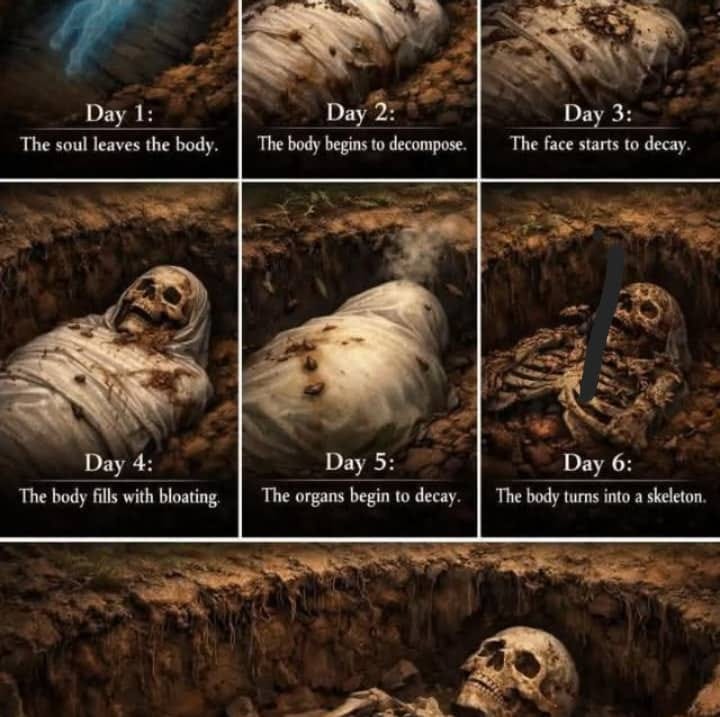
I saw a picture online recently. Six panels. Day 1, the soul leaves the body. Day 2, decomposition begins. Day 3, the face starts to go. Day 4, bloating. Day 5, the organs give up. Day 6, all that’s left is bone.
I sat with that image far longer than I expected to. Not because it was graphic, though it was. But because I’ve watched this exact timeline happen for real, more than once, to people I loved. And I’ve also watched it happen in slower, quieter ways that had nothing to do with a body in the ground. A friendship. A version of myself I liked more than the one writing this. Other people’s marriages, seen from close enough to notice the cracks before they did.
Nobody tells you that decay doesn’t only happen underground. It happens across dinner tables. It happens in group chats that go quiet. It happens inside a person while their body keeps walking around, showing up to work, smiling in photos, answering “I’m fine” on repeat.
I know that one from a few different angles now. So let me walk you through it.
Day 1: the soul leaves first
This is the quiet one. Nobody notices Day 1 while it’s happening. You only spot it later, looking back, and you go “ahh, that’s when it started.”
Years later, I can trace it with my father, small things I didn’t understand as warnings at the time and only made sense in hindsight. At the time I called it a bad week, a rough patch. Looking back, something had already started to shift before any of us were willing to name it.
It’s the same with things that aren’t death at all. I think about David, my old friend I’ve written about before, the one all the girls used to chase. I watched him fall out of love with his own hustle years before he actually walked away from it. He was still showing up, still going through the motions, but something behind his eyes had already clocked out.
I’ve had my own quieter version too. A season where I kept writing because it was “what I do,” not because I had anything left to say. The words were grammatically fine. There was no pulse in them. I was performing a version of myself instead of being him.
You don’t need a tragedy for Day 1 to begin. You just need to stop paying attention. That’s the whole trigger.
Day 2: you see it and you look away anyway
By Day 2 something is visibly off, but you’ve built a whole vocabulary to avoid naming it. “We’re just in a phase.” “She’s just busy these days.” “It’s just a rough season, everyone has one.”
With Sade, looking back at the months before March, there were calls that got shorter, plans that kept sliding to “next time.” Nothing dramatic. Just ordinary distance, the kind every family has, the kind you assume you’ll close later because family will always be there. That assumption is one grief has taught me not to trust blindly anymore.
This is also the same reason people stay in jobs they’ve quietly quit inside their own heads or keep sharing a bed with someone long after they’ve stopped sharing anything real. The rot is visible. We just decide it’s easier not to look directly at it, because looking means we’d have to do something about it.
Day 3: other people start seeing what you’ve been hiding
This is the stage where you lose the ability to control the narrative. Someone asks why you sound different on the phone. A friend asks if you’re really okay, and you realize they asked because they noticed, not because you told them anything.
In the weeks after losing Sade, I stopped being able to hide it, even on days I wanted to. People I hadn’t spoken to in a while started reaching out just from the change in my energy online, or the silence where my writing used to be. That’s Day 3. The mask thins enough that people who care about you can see through it, whether or not you’ve given them permission to look.
For a lot of us, especially the ones raised to “hold it together” no matter what, being seen falling apart feels worse than the falling apart itself.
Day 4: everything you didn’t say starts leaking out sideways
This is the bloating stage, and it’s the ugliest one because it’s when unspoken things start coming out in the wrong shape. You don’t say “I’m hurting,” you snap at someone over something small and unrelated. You don’t say “I miss her,” you go quiet for days and call it “needing space.”
I caught myself doing exactly this in the weeks after March. Irritated at things that had nothing to do with the actual weight I was carrying. Distant with people who didn’t deserve the distance. Grief doesn’t always announce itself directly. Sometimes it leaks out sideways, dressed up as impatience or silence, and if you’re not careful you start damaging things that were never the problem in the first place.
Unexpressed things don’t evaporate. They ferment. And fermented feelings always come out louder and messier than they would have if you’d just said them plainly on Day 1.
Day 5: the core systems fail
By this point trust is gone, or purpose is gone, or both. This is the stage where the thing isn’t just decaying anymore, it’s structurally compromised. No amount of a nice date night or a pep talk fixes it. The organs have failed.
Grief did this to my sense of purpose for a stretch this year. My writing, the thing that has always been the core organ of who I am, went quiet along with everything else. Not because I stopped loving it, but because for a while the belief that anything I said mattered had quietly failed too. That’s a normal part of processing loss, even if nobody warns you about it while it’s happening.
Day 5 forces a real decision. Not “let me try harder for a bit.” An actual decision. Do I fight to rebuild this, or do I finally admit something has ended and stop performing life on top of it.
Day 6: all that’s left is the shape of what it used to be
This is the skeleton stage. The relationship where two people share an address and nothing else. The dream you still mention at parties out of habit, with none of the fire that used to come with it. The version of yourself you keep introducing to new people, even though you privately know he doesn’t exist anymore.
Day 6 isn’t dramatic the way people imagine it. It’s not a big collapse. It’s quiet. It’s a person sitting at a dinner table, answering “I’m fine” on autopilot, while everyone assumes life is moving on as normal. That’s the scary part. Day 6 can look completely ordinary from the outside, which is exactly why nobody around you know to check on you unless you tell them.
What all of this has actually taught me
Here’s the thing nobody tells you about decay. Physical death happens to us, whether we’re ready or not. But relational, emotional, and creative death happens because of choices, small ones, repeated quietly over time, until the six days have already passed and you didn’t notice the clock running.
Nobody wakes up one morning and decides to destroy a relationship. It’s built from a hundred small mornings where a hug wasn’t offered, an apology wasn’t given, a “how are you, really” was never asked. Nobody wakes up and decides to kill their own dream, or their own voice. It dies from a hundred nights where the idea sat there, and nobody opened the laptop.
I used to think the opposite of love was hate. I don’t believe that anymore. I think it’s indifference. Hate at least means you still feel something. Indifference is the actual killer. It’s quiet. It doesn’t announce itself. It just slowly stops showing up, the way I stopped showing up here for five months.
Losing my parents taught me this lesson once, a long time ago, and time has softened the sharpness of it into something more like wisdom than wound. Losing Sade this year reminded me of it again, freshly enough to shake me back into paying attention. Two different distances from the same grief, teaching me the same thing twice, because apparently, I needed to hear it more than once.
The part that actually matters
If something came to mind while you were reading through the six days, sit with it for a second. Don’t rush past it.
Which relationship in your life is stuck around Day 2, where you’ve noticed the distance but keep telling yourself it’s just a phase?
Which dream did you quietly stop watering because life got busy, and you’ve been calling that busyness instead of what it actually is?
Who in your life have you been meaning to call, to visit, to tell something important, and keep pushing to “next month” because you assume next month is guaranteed?
I’m not writing this from some place of having it all figured out. I’ve buried grief twice now, in two very different ways, and both times it taught me the same lesson from a different angle. Some things really can be caught at Day 3 or Day 4 if you’re honest enough to look. And some things you can only honor after they’re gone, by refusing to let their memory turn into a Day 6 skeleton in your own life. By actually living differently because of what they meant to you.
Nothing dies all at once. It always gives warning signs first. If you’re paying attention, you’ll hear it.
Thank you for being patient with my silence these past five months. I’m back. And honestly, I needed this piece to find its way back to writing again.